
Mini Skincare Fridge: What Goes In, What Stays Out

Your guides through the skincare chaos
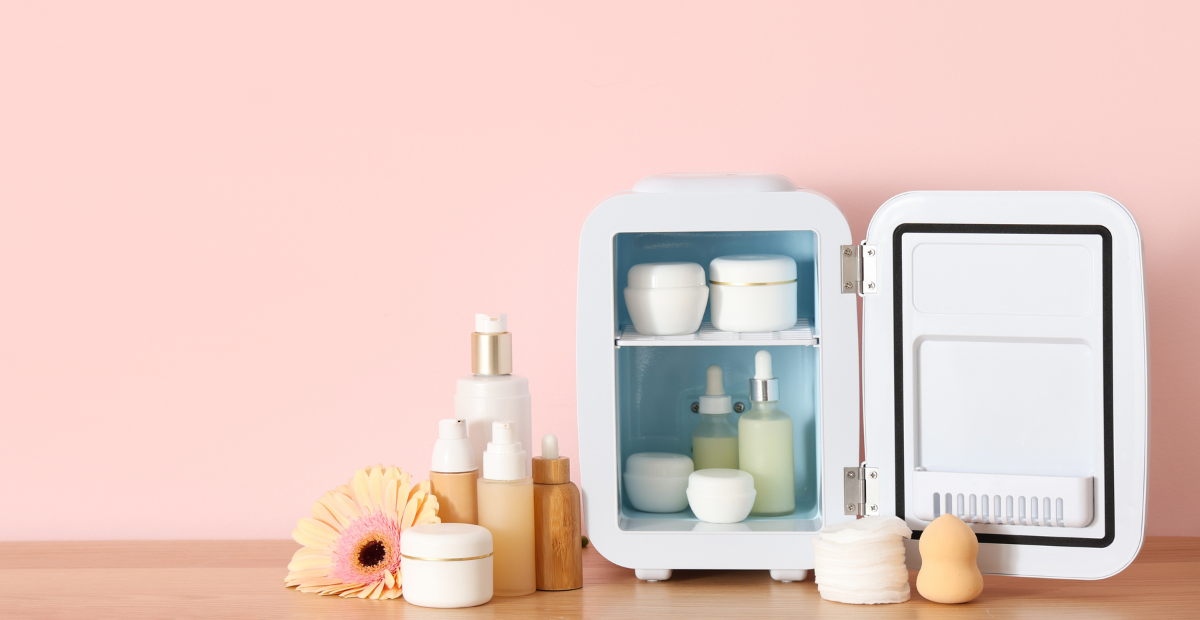
You got yourself a skincare fridge? Great! Now what? The idea of owning a fridge specifically for beauty products can seem appealing, but in reality, not every product benefits from a chilly environment. In fact, some formulas are perfectly fine at room temperature—refrigerating them just adds to your energy bills.
Which formulas? Well, that’s what we’re here to find out. Learn exactly what to put in a skincare fridge to help your favorite beauty products last longer and perform their best.
What’s a skincare fridge?
A skincare fridge is a compact, insulated cooler that keeps products at a consistent, low temperature—typically around 40–54°F (or 7–12°C). It may seem unimpressive, but unlike the food in your kitchen refrigerator, your beauty products don’t need to be kept completely chilled.

The main appeal of a mini skincare fridge is twofold: preservation and experience. Firstly, heat and light are known enemies of many potent skincare ingredients and can cause them to degrade faster. Secondly, the cooling effect can physically constrict blood vessels in your skin. This can temporarily reduce puffiness and soothe irritation (and it feels nice, too!)
What skincare goes in the fridge
The best candidates are products with unstable ingredients (actives that degrade when exposed to light, air, or heat) and formulas meant to soothe or depuff.
#1 Vitamin C serums
Vitamin C is notoriously unstable and prone to oxidation. When it oxidizes, the product’s effectiveness declines. Refrigerating your vitamin C serum helps slow this process and keeps the product potent for longer.
#2 Retinoids
Similar to vitamin C, retinoids can degrade when exposed to heat and light. On the flip side, their stability improves significantly at lower temperatures, so keeping your retinol cream in a cool place can help maintain its efficacy over time.

#3 Eye creams and gels
Probably the first thing you’d want to put into your skincare fridge. Chilled eye creams can feel very nice on your skin, especially if you’re experiencing some puffiness. The coolness constricts blood vessels, which in turn reduces swelling.
#4 Sheet masks
Applying a cool sheet mask at the end of a busy day can be a great way to decompress. The cooling sensation is both refreshing and calming, and can be quite effective at soothing irritated skin. Cooling sheet masks are especially helpful if you’re dealing with redness and sensitivity.
#5 Natural and organic products
Products with fewer preservatives are more susceptible to spoilage. A skincare fridge benefits many natural extracts, which oxidize more slowly when refrigerated.
> Quick tip: If you’re on the fence about whether a product belongs in your fridge (or your routine) at all, give it a quick scan before checking out at the store.
What not to put in a skincare fridge
Here’s what you should know about the products that don’t do so well in cold storage.
#1 Oil-based products
Cold can thicken or cloud certain oils. It won’t ruin their effectiveness, but it can make application less pleasant. So if texture is a priority, skip refrigerating oil-based products.
#2 Clay and peel-off masks
You don’t want your clay masks to harden and become impossible to spread evenly. Moreover, the water content in clay formulations can sometimes separate from the mineral particles in colder temperatures.
#3 Thick creams and moisturizers
Like oil-based products, heavy creams can become difficult to dispense and may separate in colder temperatures. Emulsions are especially poor candidates for your skincare fridge, since they contain both water and oil.
> Quick tip: The easiest way to figure out what things to put in a skincare fridge comes down to one simple rule. If a product is a water-based gel or serum, it’s likely fine to keep it refrigerated. If it’s an oil or a thick balm, leave it in your regular skincare drawer.
What else you can put in a skincare fridge
Beyond actual skincare, there are other things you can keep in your skincare fridge.

Facial rollers and gua sha tools
Storing jade rollers and gua sha stones in a cool place can amplify their depuffing effect. The cold stone combined with massage can encourage lymphatic drainage and enhance circulation. Plus, a cool stone tool feels much nicer.
Eye drops
You definitely don’t want eye drops so cold they’re uncomfortable, so it’s a good thing skincare fridges aren’t as chilly as the regular ones. Slightly cool drops can feel amazing after a day spent staring at screens.
How to organize a skincare fridge
You don’t want your mini skincare fridge to become a maxi mess. Functionality is important here. A well-organized fridge ensures you can grab what you need quickly and prevents items from getting lost in the back.
Step 1: Categorize by frequency of use
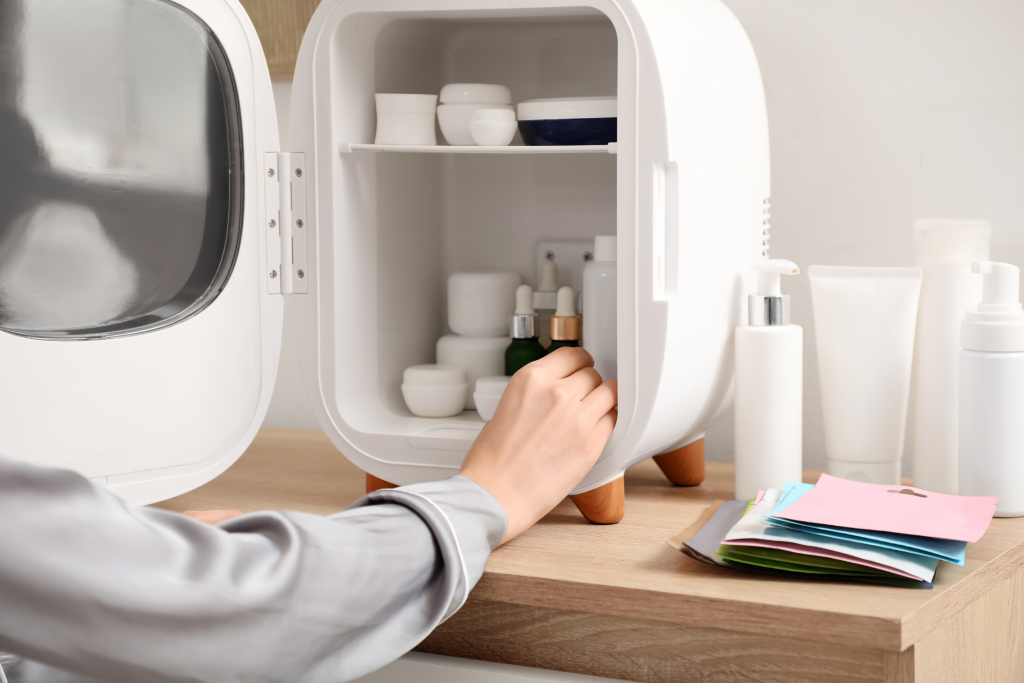
This one’s pretty straightforward. Place the products you use daily on the top shelf or in the door compartment where they’re easiest to reach. Save the deeper shelves for the things you only use occasionally, like sheet masks or facial tools.
Step 2: Store by temperature sensitivity
Put the most temperature-sensitive items, like vitamin C serums and retinoids, in the coldest part of the fridge (usually at the back). Everything else, like toners and mists, can stay in the front.
Step 3: Use bins or trays (optional)
If your skincare fridge has room, consider adding small organizer bins—they can help corral similar products together. Think one bin for eye treatments, another for serums, and a third for sheet masks. This keeps everything easily accessible and prevents you from rummaging around.
Key Takeaways
- Keep in: Vitamin C, retinoids, eye creams, masks, and organic products are best stored in the fridge.
- Leave out: Oils, clay masks, emulsions, and heavy creams don’t fare well in cold storage.
- Rule of thumb: Water-based, active ingredient-focused products go in; oils and thicker products stay out.
- Don’t stop at skincare: Facial rollers, gua sha stones, and eye drops can benefit from lower temperatures.
- Stay tidy: Use bins or trays to keep your beauty products organized.


-
1.
Stability and stabilization of ascorbic acid. (2015). https://www.researchgate.net/publication/321148774_Stability_and_Stabilization_of_Ascorbic_Acid
-
2.
Retinoid stability and degradation kinetics in commercial cosmetic products. (2021). https://pubmed.ncbi.nlm.nih.gov/33206444/
-
3.
Facial icing: Is ice good for your face? (2021). https://health.clevelandclinic.org/facial-icing