OnSkin U.S. Cosmetic Consumer Survey: Safety and Science Are Reshaping Beauty Buying Decisions

Your guides through the skincare chaos
Over the past decade, the cosmetic industry has focused on creating aspiration through flawless looks, eye-catching packaging, influencer-led launches, and viral products that promise quick results. But beneath the surface, consumer priorities are shifting in ways that may reshape the beauty market.
A new survey of 1,700 U.S. consumers conducted by OnSkin reveals that cosmetic buyers have significantly become safety-oriented, ingredient-aware, and skeptical of traditional beauty marketing claims—and are actively changing their purchasing behavior in response.
The findings point to a broad move away from passive or trend-driven cosmetic consumption toward informed, personalized choices and health risk management. Scientific and medical substantiation appears to carry essentially more weight in the consumer mindset than branding or influencer culture.
Consumers Are Replacing Influence With Verification
Cosmetic- and beauty-related decisions are becoming increasingly data-driven. Survey results show that consumers trust professional, scientific, and independent verification sources over marketing.
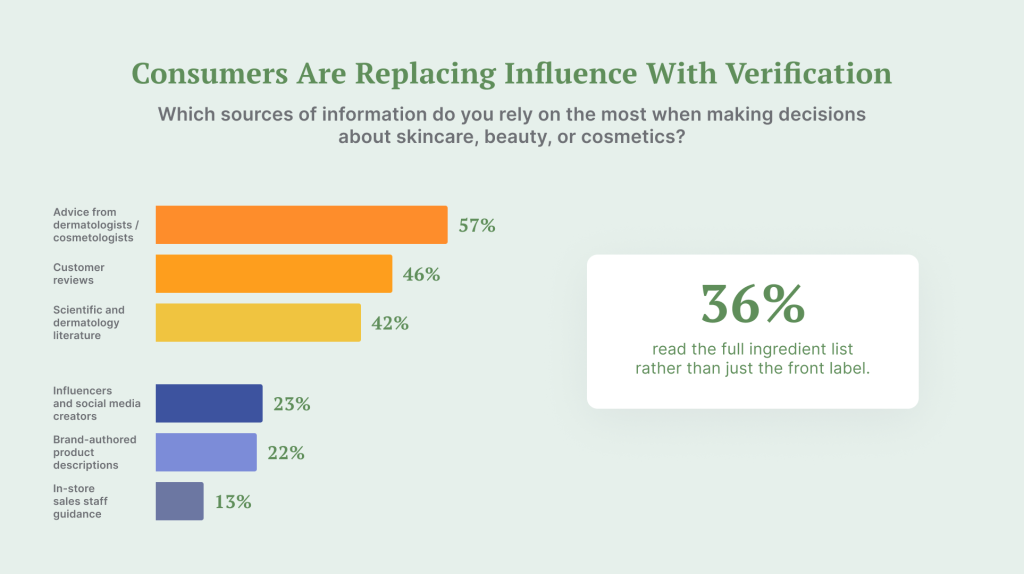
When asked which information sources they rely on most when making decisions about skincare, beauty, and cosmetics:
- 57% cited advice from dermatologists and cosmetologists;
- 42% consult scientific and dermatology literature;
- 46% explore customer reviews.
36% of survey respondents said they now read the full ingredient list rather than just the front label. Only 22% view brand-authored product descriptions as definitive, while just 13% rely on in-store sales staff guidance. These findings point that the front-label economy may be weakening.
Furthermore, only 23% named influencers and social media creators as trusted sources of information, suggesting a potential decline in the perceived credibility of their recommendations.
While most consumers rely on experts and real-world reviews to validate trust, the rise of independent cosmetic scanner apps is also notable in the consumer decision-making hierarchy, with 54% of respondents reporting that they use them. A few years ago, ingredient decoding required specialized knowledge. Today, technology has democratized this process, enabling consumers to instantly scan products, review ingredient breakdowns, and assess potential concerns in real time.
Safety Has Become the Dominant Cosmetic Purchase Driver
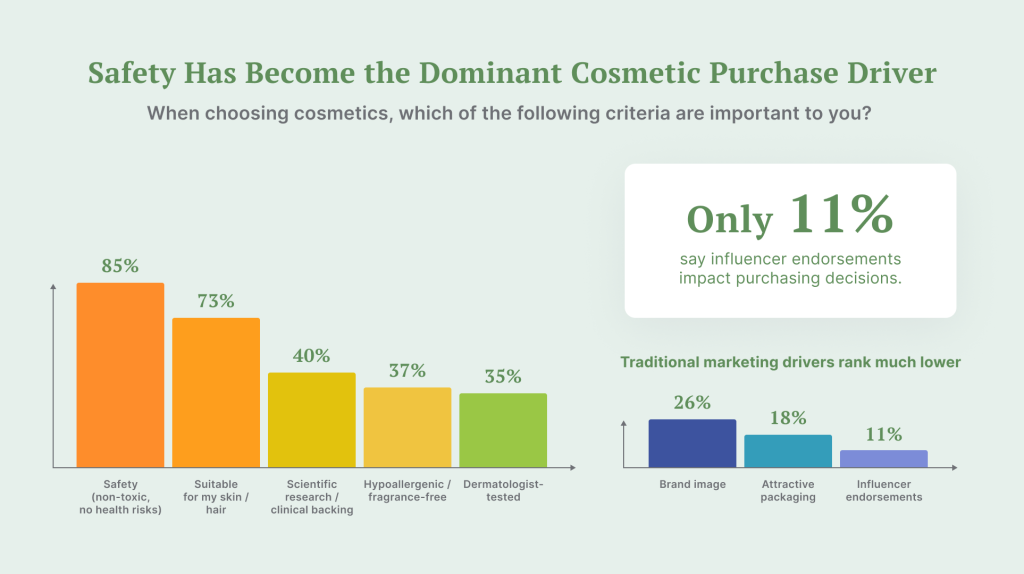
When respondents were asked what matters most when choosing cosmetic products, safety overwhelmingly ranked as the top priority.
- 85% said safety (non-toxic formulations and the absence of health risks) is important when selecting cosmetics;
- 73% prioritize suitability for their individual skin or hair;
- 40% value scientific research and clinical backing;
- 35% specifically look for dermatologist-tested labels;
- 37% seek hypoallergenic or fragrance-free labels.
Notably, traditional cosmetic marketing drivers ranked dramatically lower:
- Only 26% said brand image strongly influences purchasing decisions;
- Just 18% care about attractive packaging;
- Only 11% rely on influencer endorsements.
These findings suggest a strategic shift in purchasing criteria, with consumers viewing cosmetics not only from the functionality and lifestyle appeal standpoints, but also as products with direct health implications.
Consumers appear less persuaded by aesthetic branding, sensory experience, or influencer hype, and more by formulation safety, scientific evidence, and skin or hair compatibility.
Ingredient Awareness Has Gone Mainstream
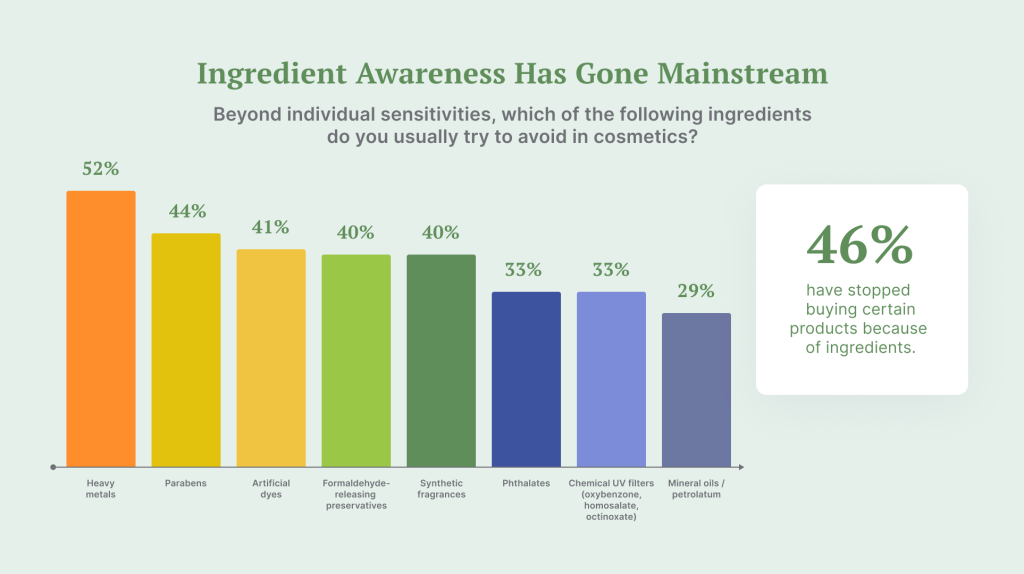
Survey results indicate that ingredient-avoidance behavior has gone mainstream rather than remaining a niche, with 46% of respondents reporting that they have stopped buying certain brands or products because of their ingredients.
Importantly, a significant portion of respondents distinguish between controversial chemicals and react to specific ingredient groups associated with allergies, endocrine disruption, genotoxicity, and other health concerns.
Among respondents:
- 52% avoid heavy metals;
- 44% avoid parabens;
- 41% avoid artificial dyes;
- 40% avoid formaldehyde-releasing preservatives;
- 40% avoid synthetic fragrances;
- 33% avoid phthalates;
- 33% avoid chemical UV filters (oxybenzone, homosalate, octinoxate);
- 29% avoid mineral oils / petrolatum.
Just 28% said they don’t avoid any ingredients in particular.
At the same time, 39% of respondents said that the inclusion of specific active ingredients they seek out (e.g., niacinamide, hyaluronic acid, etc.) determines their positive purchasing decisions.
These findings point to a more informed consumer landscape characterized by growing ingredient literacy and closer review of product formulations.
“Clean Beauty” Has a Credibility Problem
“Clean beauty” has been one of the industry’s dominant marketing messages for years. Among the survey respondents, only 4% said they had never heard the term in relation to cosmetics.
However, the survey results also show that consumers remain uncertain about whether the term truly reflects product safety or transparency.
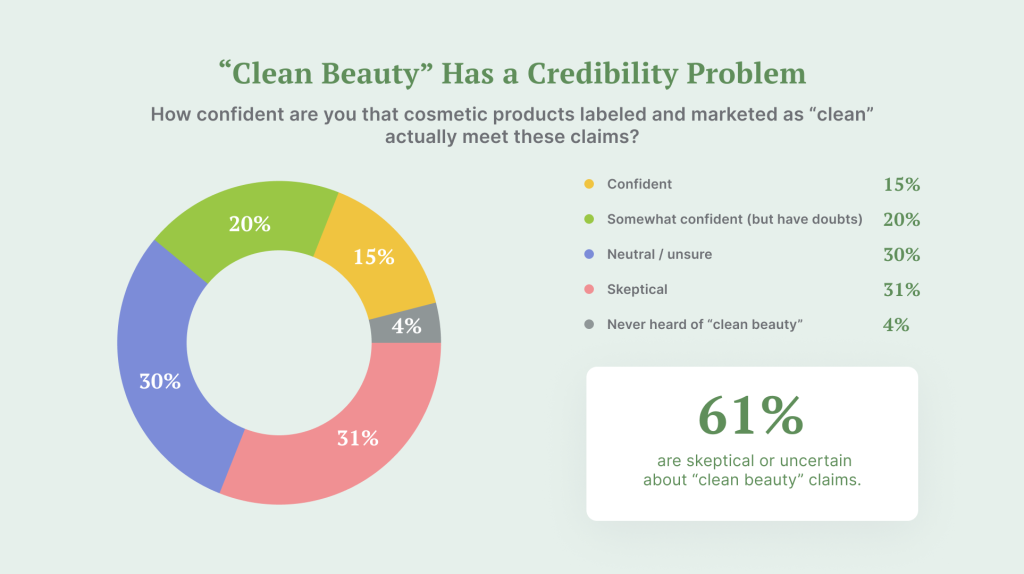
When asked whether they trust that products marketed as “clean” actually meet that claim:
- Only 15% said they are confident;
- 20% said they are somewhat confident but occasionally have doubts;
- 30% said they are neutral or unsure whether these claims are accurate;
- 31% expressed skepticism.
Combined, skeptical and uncertain consumers significantly outnumber trusting consumers.
It may indicate that the clean beauty movement is entering a new phase. Early-stage clean beauty marketing often relied on broad emotional positioning and loosely defined terms (e.g., “chemical-free,” “natural,” etc.). Today, consumers appear to want specificity rather than generalized wellness language, expecting brands to substantiate cleanness with scientific and clinical research and full ingredient transparency.
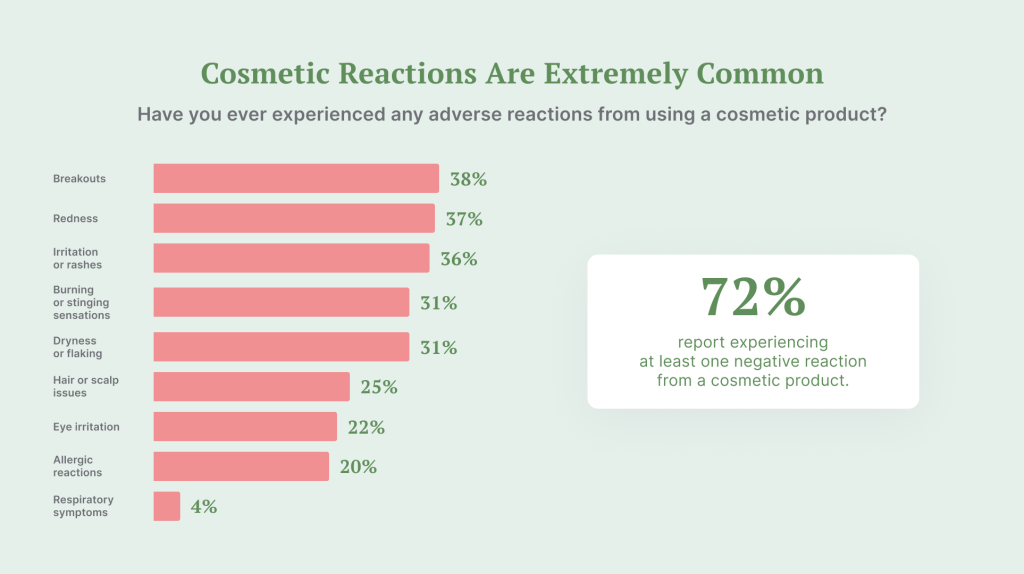
Cosmetic Reactions Are Extremely Common
One of the survey’s most notable findings is how widespread adverse cosmetic reactions are.
Only 28% of respondents said they had never experienced a negative reaction from a cosmetic product.
The remaining majority reported at least one issue:
- 38% experienced breakouts;
- 37% experienced redness;
- 36% reported irritation or rashes;
- 31% experienced burning or stinging sensations;
- 31% reported dryness or flaking;
- 25% experienced hair or scalp issues;
- 22% experienced eye irritation;
- 20% reported allergic reactions;
- 4% reported respiratory symptoms.
It suggests that cosmetic safety concerns are not theoretical—they are experiential. Consumers are not becoming safety-focused in a vacuum. Many are responding to direct personal experiences with adverse effects caused by products they have used.
Health Risks Prompt Consumers to Abandon Favorite Products
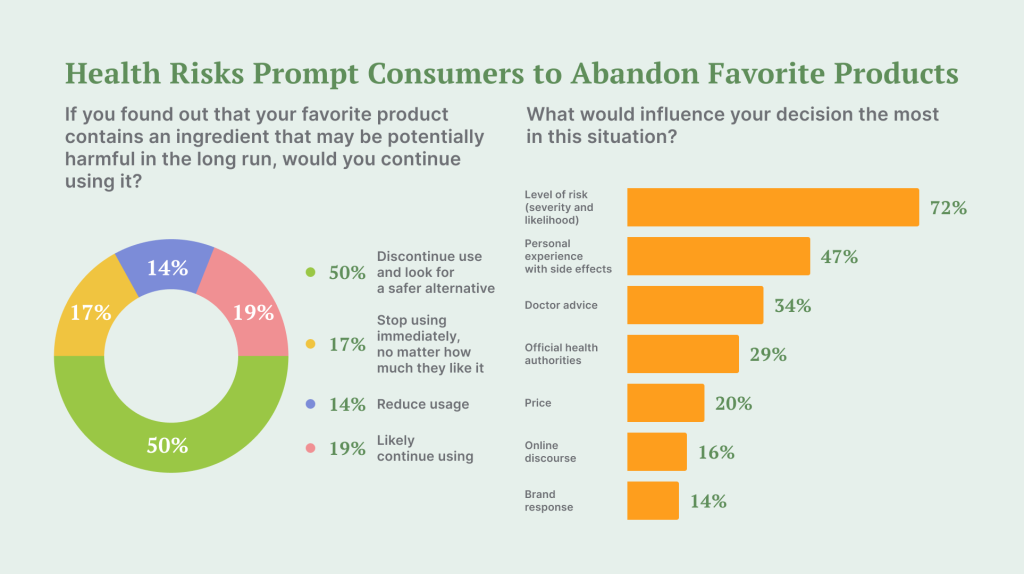
The survey also explored how consumers would react if a favorite cosmetic product were found to contain a potentially harmful ingredient.
The response was decisive:
- 50% said they would discontinue use and look for a safer alternative;
- another 17% said they would stop using the product immediately, regardless of how much they liked it;
- 14% said they would reduce usage.
Only 19% said they would likely continue using the product, either because they don’t consider the risk significant or unless visible side effects appear.
It means roughly two-thirds of consumers would discontinue use due to potential long-term health problems an ingredient may cause.
When asked what would influence their decision the most:
- 72% cited the level of risk, such as the severity of the health concern and the statistical likelihood of negative outcomes;
- 47% cited personal experience with side effects;
- 34% would rely on doctor advice;
- 29% would look to statements from official health authorities.
Only 16% said online discourse would be their primary influence, while just 14% would consider a brand’s response to safety concerns.
Price was also a relatively minor factor, with only 20% of respondents saying cost would be a deal breaker in such situations.
These findings prove that cosmetic consumers become increasingly cautious in their decision-making when health risks are involved.
Consumers Are Willing to Pay More for Safer Products
The survey suggests that cosmetic product safety is not only a compliance expectation, but also a competitive differentiator that may carry financial value.
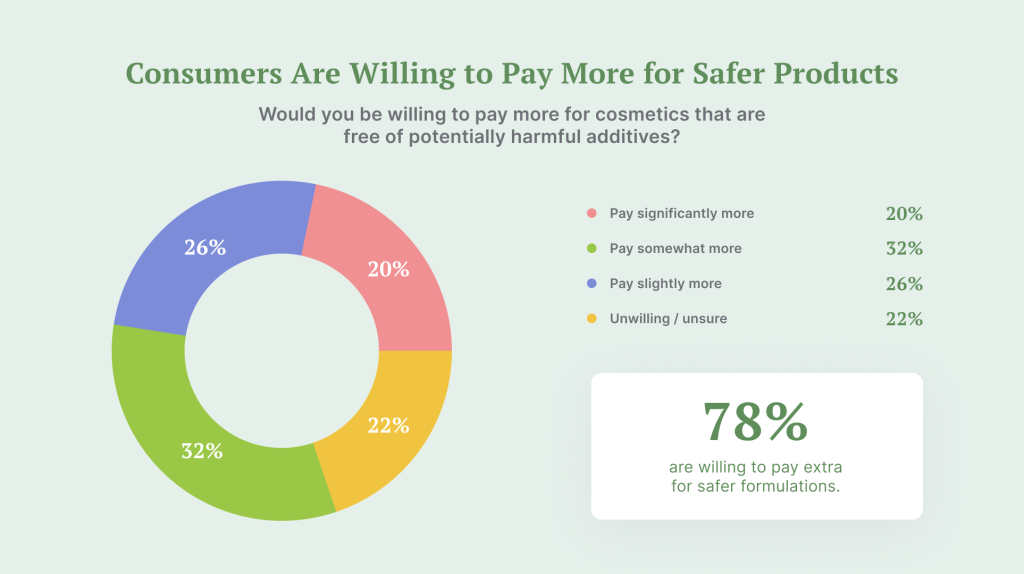
When asked whether they would pay more for products that are completely free from potentially harmful ingredients:
- 20% said they would pay significantly more;
- 32% said they would pay somewhat more;
- 26% said they would pay slightly more.
In total, 78% expressed at least some willingness to pay extra for safer formulations.
This finding is particularly notable given that price remains important to a significant share of consumers: 47% cite affordability as one of the primary purchase criteria, and 38% emphasize value for money.
Daily Cosmetic Exposure Is Extensive
Product-dense daily routines provide a contextual insight that makes the growing preference for safer options even more psychologically and behaviorally understandable.
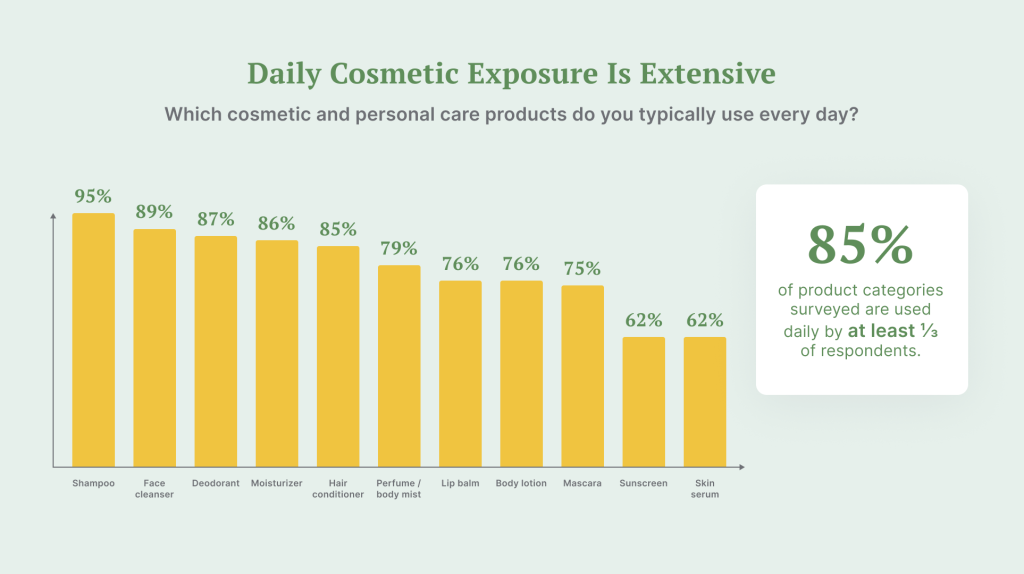
The overwhelming majority of cosmetic and personal care products are not occasional-use items, but high-frequency, long-term exposure products.
85% of the product categories surveyed across skincare, haircare, body care, makeup, and fragrance were reported to be used daily by at least one-third of respondents.
Daily-use rates were significantly high across multiple categories:
- 95% use shampoo daily;
- 89% use face cleanser;
- 87% use deodorant;
- 86% use moisturizer;
- 85% use hair conditioner;
- 79% use perfume or body mist;
- 76% use lip balm;
- 76% use body lotion;
- 75% use mascara;
- 66% use blush;
- 62% use sunscreen;
- 62% use skin serum.
The level of daily product exposure reported by many respondents can amount to hundreds of chemicals used repeatedly over the years. This intensity may contribute to growing consumer concerns about cumulative effects, driving broader demand for ingredient transparency and risk reduction.
Takeaway
Taken together, the survey findings point to consumers predominantly approaching cosmetics less like discretionary lifestyle products and more as long-term wellness decisions.
The traditional beauty marketing model, often built around aspirational branding, influencer authority, and trend cycles, appears to be losing effectiveness. An evidence-driven consumer culture is taking its place. It doesn’t mean aesthetics, branding, or emotional appeal are no longer relevant. However, the survey strongly suggests that these factors now play a secondary role to safety and credibility.
Consumers are becoming:
- more ingredient-conscious;
- more skeptical of vague marketing claims;
- more reliant on scientific and professional validation;
- less impacted by influencer endorsements;
- more willing to change purchasing habits in response to health risks.
Consumers increasingly expect cosmetic brands to deliver not only performance but also transparent ingredient disclosure and proactive accountability for the safety profiles of the products they market.
Brands that fail to meet these expectations may face growing skepticism, while those that do are likely to build stronger, more sustainable consumer trust.
Julia Kuprina, OnSkin’s Product Director, said:
“Consumers in the United States, the world’s largest beauty and personal care market, have grown more skeptical and harder to influence. They want proof, not promises; results, not rhetoric; and safety, not smoke and mirrors.
While persuasive advertising and aestheticized beauty content remain central to the industry, behaviors once limited to highly engaged or niche consumers, such as reading ingredient lists, fact-checking marketing claims, and assessing health impacts before purchasing daily-use cosmetic products, are now becoming mainstream.
These actively changing decision-making patterns highlight scientifically substantiated product performance and accountability for long-term product safety as key factors in building consumer trust and gaining a competitive edge.”
Methodology
The online survey was conducted by OnSkin in Q3 2026 among 1,700 U.S. respondents to better understand current cosmetic consumer behavior.
Participants were asked a series of multiple-choice questions about:
- cosmetic purchasing criteria;
- cosmetic use patterns;
- trust in information sources;
- cosmetic ingredient concerns;
- adverse product experiences;
- clean beauty perception;
- price considerations.
The survey was conducted anonymously among the OnSkin community. The survey sample consisted of active cosmetic consumers across multiple age groups, including a significant Gen Z segment (61%). Respondents were predominantly female (90%), reflecting the core demographic composition of the cosmetics market.
For the full breakdown of each survey question, including all response options and corresponding percentages, see the Data Appendix.
Percentages may not total 100% due to rounding and multi-select question formats.
Age
Gen Z (14-29) – 61.3%
Millennials (30-45) – 20.4%
Gen X (46-61) – 14.1%
Boomers (62-80) – 4.3%
Gender
Female – 90.2%
Male – 6.3%
Non-binary – 0.7%
Prefer not to say – 2.4%
Other – 0.4%